
The Spotlight presentation at Day 1 of HubSpot's 2026 Unbound (formerly Inbound) conference made one thing clear: better AI outcomes depend on better context, not more tools.
HubSpot opened Unbound with a message a lot of teams needed to hear: stop chasing AI for the sake of AI and start using it to achieve actual outcomes.
The Day 1 Spotlight session, featuring CEO Yamini Rangan and CPTO Duncan Lennox, focused on a bigger idea than product novelty. HubSpot’s position was that AI should be judged by outcomes, not by how many tools a company has turned on .
That landed with us.
At Flawless Inbound, our biggest takeaway from the session was simple: the future of AI inside HubSpot will belong to companies that have the right foundation, the right context, and a clear idea of what they are trying to improve.
That was the real story of Day 1.
Key Takeaways: HubSpot Unbound Day 1 Spotlight
- HubSpot framed AI success around business outcomes, not experimentation volume.
- The strongest message from the stage was that context determines whether AI helps or creates more noise.
- Smart CRM, Context Home, Breeze Assistant, and Agent Builder all point toward a more connected operating model.
- HubSpot is trying to reduce manual admin while tightening the link between insight and execution.
- For B2B teams, the real opportunity is not more AI activity. It is better AI grounded in cleaner systems and better context.
What HubSpot Said the AI Era Gets Wrong
A lot of AI conversations still revolve around optics. How many assistants a company is using? How many workflows it has launched? How quickly can it say it adopted AI?
HubSpot pushed in a different direction.
HubSpot's CEO Yamini Rangan opened the session with a challenge:
“Stop asking what technology can do and start asking what it should do. . .That’s what transformational companies are doing.”
-Yamini Rangan, CEO, HubSpot
That line gets to the heart of the issue. Most companies do not need more AI activity. They need more useful AI activity tied to real business movement. HubSpot’s broader event messaging echoed that same point, positioning Spotlight around how AI grounded in business context can help teams build demand, win deals, and delight customers .
Our interpretation is that HubSpot is trying to move the conversation away from experimentation for its own sake and toward disciplined, outcome-based application.
Why Context Was the Most Important Theme of the Session
The single most important idea from Day 1 was not a feature release. It was the argument underneath the releases: Good context drives great outcomes.
The case was straightforward: AI performs well when it understands your customers, your business, your team, and the real interactions happening across your revenue motion. Without that, it produces polished output built on incomplete information.
That is why another line from Rangan hit so hard:
“AI with bad context is worse than having no AI at all.”
-Yamini Rangan, CEO, HubSpot
And this is back up with data. In HubSpot's own surveys and research they found that for all of the positive metrics context-built AI helped deliver (increase MQLs, faster close rates, more customers, etc.) those exact same metrics got worse when bad AI was employed instead.
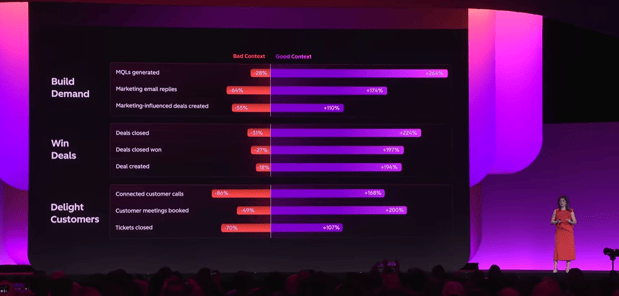
If your CRM is incomplete, if your data entry is inconsistent, if your lifecycle and handoffs are unclear, AI does not fix the underlying issue. It scales it. The output may look faster and cleaner, but the logic underneath is still broken.
The Three Traits of Companies Winning With AI
One of the most practical parts of the session was the framework for what successful companies are doing differently. There were 3 steps:
1. Focus on outcomes
The first question is not which tool to use. It is whether you know the outcome you want.
That means choosing use cases tied to real movement in the business: better routing, stronger follow-up, cleaner forecasting, more useful reporting, or more effective campaign execution.
Teams that get value from AI are not using it everywhere. They are using it where it can improve something measurable. In fact, Rangan shared that the companies they surveyed that showed the most growth from AI usage, only had 4-5 use-cases at a time.
2. Build the foundation
HubSpot made the foundation piece impossible to miss.
CRM and context sat at the center of the entire Spotlight story. The session itself was positioned as a look at trends in AI, marketing, sales, and service alongside new platform innovation . But the bigger message was that innovation only matters if the underlying system reflects reality.
That means your records are usable. Your processes are defined. Your activity is captured. Your data structure gives AI something trustworthy to work with.
3. Invest in AI and people
HubSpot also avoided the usual trap of talking about AI as a replacement for thinking.
“The bar on building has gone down. The ceiling on thinking has gone up.”
-Yamini Rangan, CEO, HubSpot
That feels like the right way to describe this moment. AI lowers the barrier to execution. It does not lower the need for judgment. If anything, it increases it. As the tools get more capable, strategy matters more, not less. So it's important to not just invest in the tools that use or implement AI but in the people who execute it. The ones who think of all of the ways it can be used to generate actual outcomes. To delight actual customers.
Part 2: The Product Updates That Stood Out Most
There were hundreds of updates shipped in the lead up to and at Unbound this year, and we will be writing more about our favourites in the days to come. But a handful from today's Spotlight session stood out immediately because they all support the same direction: less manual work, better context, and more coordinated execution.
Self-updating CRM
Duncan Lennox summed up a longstanding CRM problem in one line: “A CRM only knows what someone remembers to tell it.”
That is a sharp diagnosis of why so many systems become unreliable over time.
HubSpot’s answer is a self-updating Smart CRM designed to automatically capture and sync information from calls, emails, and meetings . If that works the way HubSpot intends, it addresses one of the biggest friction points in CRM adoption: teams hate manually updating the system, and the system degrades when they do not.
Context Home
Context Home may end up being one of the most important foundational layers of HubSpot as a platform. It's simply a way for organizations to provide the AI agents in your portal (Breeze, pre-built Agents, or custom ones) your identity and voice as a company.
Simply pop into the Agent Hub (the diamond shaped navigation item) and add in everything from your brand kit, to your ICPs, to your product-service information, team, and so much more. From there, all of the AI-using systems in HubSpot will have that context and will be able to operate, as we mentioned is necessary for success in Part 1, with a solid foundation.
The new Breeze Assistant
The new Breeze Assistant was another major highlight.
From our perspective, the biggest shift is that Breeze is moving beyond answering questions and into actually orchestrating work that will help teams be more efficient in their day to day.
The new assistant can now help with planning, building, and deploying assets and automations across your CRM.
For Marketing teams that means working with the assistant to plan and build full marketing campaigns. It can even start from an idea. Try asking it where gaps in your pipeline might be and use that data to start iterating on a campaign. With all of the brand context from Context Home, it can help take a campaign from idea to executed in a short time.
For Sales teams the new Breeze means running through a full ABM motion. Try asking it to help build out a prospecting campaign for a target account. Or, you might use the new Breeze to not only build a report on open deals, but create a formatted, easily digestible one to share with your manager.
Agent Builder
Agent Builder stood out because it points toward a more customizable future inside HubSpot. The promise is straightforward: describe what you need, and HubSpot helps you create a custom agent inside the platform.
That matters for teams with specific workflows, specialized internal processes, or recurring use cases that do not fit neatly into a one-size-fits-all assistant experience.
Just remember, that custom agents (and lots of the pre-built ones) do cost credits. So make sure you are aware of the consumption and have the appropriate limits in place before creating unlimited agents.
ChatGPT Ads integration
HubSpot annouced that they are the first CRM to have an integration with ChatGPT ads. This new capability comes as part of a broader push to help marketers show up in the channels where discovery is shifting, especially as AI-driven search and answer engines change buying behavior .
Jump into Ads (under Marketing in the navigation) to have a look and get started for yourself.
What These Updates Mean for HubSpot Customers
The practical takeaway from Spotlight is not hard to see.
HubSpot is trying to reduce the manual work that keeps CRM data incomplete. It is trying to give AI better context so the output becomes more useful. And it is trying to connect planning, execution, and reporting more tightly across the platform.
Too many companies are still treating AI like a layer they can drop on top of messy systems. HubSpot’s message at Unbound was the opposite: get the foundation right, get the context right, and then let AI help you move faster.
What's Next?
We are excited to keep following the rest of Unbound and to keep unpacking the releases that matter most for teams trying to use HubSpot more intelligently. Keep an eye on our blog for more useful information.
Or, if you're reading this before Sept. 24, register for the Sales Enablement HubSpot User Group's (hosted by Flawless) recap session by clicking right here!
 Feel like talking updates in person instead? No worries, you can always let us know you want to connect by reaching out directly to our team here.
FAQs About HubSpot Unbound Day 1 Spotlight
What was the main message of HubSpot’s Day 1 Spotlight session?
The core message was that AI works best when it has the right business context. HubSpot focused on outcomes, CRM foundation, and context quality more than feature volume.
What is Context Home in HubSpot?
Context Home is HubSpot’s new way of providing AI agents in HubSpot with the much needed foundation that is information about your company, customers, and team.
Why does context matter so much for AI in HubSpot?
Because AI depends on the information it can access. If the the information is incomplete, outdated, or incorrect, the output may sound polished while still being wrong, leading to poor outcomes.
Which Day 1 updates stood out most?
The biggest standouts were: Context Home, Breeze Assistant, Agent Builder, and the ChatGPT Ads integration.